
How to Avoid State Reading Test Surprises
Assessments. When it comes to literacy, it seems we’re inundated with them lately. Screeners. Diagnostics. Curriculum-based measures. Computer adaptive. There’s really no shortage.
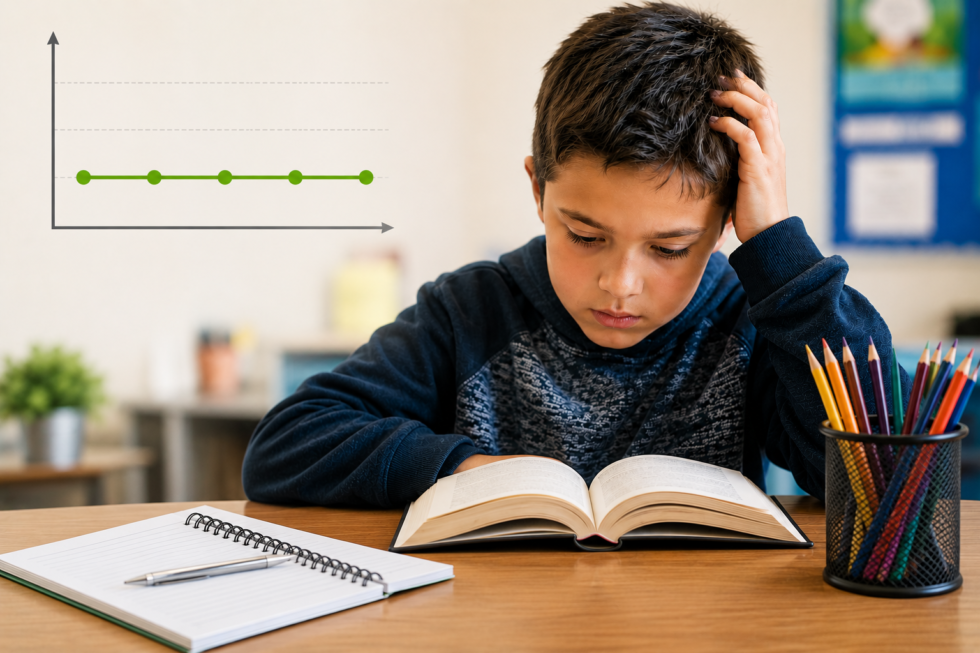
Which is a really great thing. Taken together, they help us determine who’s on track and who’s at risk for reading failure. They give us insight into next instructional steps. In using these tools, what we hope for the most, of course, is that our students will reach grade-level proficiency. And when we see that kids are “in the green,” we’re very happy.
So we carry on, all year long, guided by the data we gather. We focus our biggest efforts on the kids that were not “in the green.”
The problem though, is that too often, they become the only lens through which we view readers.
Then, before you know it, it’s time for the high-stakes end of year state reading test. Eventually, the scores come back.
And all too often, when we see how each child performed, we shake our heads. Shrug our shoulders. Sometimes, we’re in shock.
Because there will sometimes be low state test scores we didn’t see coming.
Which doesn’t match the “in the green” scores we saw all year on other assessments.
Which leads to a barrage of conjectures to explain why. These often include:
- “They rushed through it”
- “They were burned out by that time”
- “Spring fever had set in”
- “They were really sleepy that day”
- “They just clicked to get it done”
And any number of additional explanations. Which all might very well be possible. We cannot, of course, control what students actually do on the day of the test. These are very real things that happen.
But when we see this happening multiple times across multiple classes, not just a single class, we must ask ourselves: what if there’s more going on?
What if our other assessments showed us that students were on track and weren’t flagged for needing further attention were….not right?
What if we missed a key piece of the puzzle that would explain these sorts of end of year state reading test surprises?
Many districts now use some sort of oral reading fluency measure. Directions on these tests merely ask teachers to cross out words the child missed. No sort of running record is taken. This all means teachers miss out on noting reading behaviors, fluency, and strategies a child uses (or doesn’t use) to figure out unknown words. And not much of a way to indicate whether the child really understood it. As long as students read a lot of words correctly in a minute, they pass. There is often a retell component, which is great, but students may be asked to retell based on only 40 words.
Students might also be given a version of a cloze test, like MAZE, where the missing words are extremely obvious, and are the only choices that fit grammatically. While this is touted as a comprehension test, it’s barely surface-level at best. This really assesses vocabulary and grammar structure, not meaning. For example, here’s a practice question from MAZE, where students circle the correct missing word: After playing in the dirt, Sam went (home, summer, was) to wash her hands.
This is what is considered to determine “student’s ability to construct meaning from text using word recognition skills, background information and prior knowledge, familiarity with linguistic properties such as syntax and morphology, and reasoning skills.” It’s sentence level “comprehension,” as students are not asked to show comprehension of the whole text at all.
This assessment is often given to students to read silently, so again the teacher would miss out on capturing the reading behaviors and strategies a child uses (or doesn’t use). We also have no idea if students are really even comprehending, or just guessing. MAZE even acknowledges that this is a strong possibility, as their own scoring system “compensates for student guessing.”
Which means many students will be “in the green” here, too.
But it’s pretty easy to see why this sort of assessment is never going to tell us that there may be comprehension difficulties. And that means it may not show up until way after the fact, when those state assessment scores come out. And those students move on to the next grade level, where text complexity will only increase.
These same students might also do okay on other measures, like those computer-adaptive assessments. These assessments contain a heavy number of vocabulary and grammar questions–easiest to ask in multiple choice format, but do also include some very short passages which might ask students to choose the best summary. Students don’t ever have to totally come up with anything on their own; they just have to pick from a given set of answers.
Again, the teacher misses out on actually seeing and hearing what the child does as a reader. Instead, we rely on reports generated by a computer program and hope they tell the full story. But hoping isn’t the same as knowing. Especially considering these sorts of assessments aren’t all they’re cracked up to be.
How often do these students, then, get shuffled along, with undetected comprehension struggles?
While we tend to focus the majority of our time and attention on the students that don’t do well on these measures, how many students are we missing? How can we better ensure that these students aren’t falling through the cracks?
Simple.
First, bother to take the extra small effort to take a running record–not just cross off errors-when conducting screeners like ORF. If the term “running record” makes you squirm, call it the more currently used term, “record of oral reading.” It’s the same exact thing, just worded in a different way. A tiny bit of effort here will give you a great deal of helpful information.
Second, take time to confer with students. All students. Nothing can replace actually hearing a child read and then talking a bit about the book. Ask them a couple of questions, too. It’s very helpful to pause them after a section or page, and ask what’s going on. Or ask them about a particular phrase or word–what they say will tell you a lot.
While there are certainly many problems with the F & P benchmark assessment, including listening to students read and having a conversation about it are some of its best aspects. Apects that are sorely missing in most of the assessments widely used today.
Third, consider adding in a more comprehensive measure, like the CUBED-3 for those “in the green” students. It’s completely free, and one of the best tools out there for truly understanding how well a child can comprehend–and where the breakdown may be.
Word to the wise: take advantage of the training on how to conduct and analyze it to get the most from it. It’s given one-on-one and takes about ten minutes per child to conduct (and about 15 minutes to score), but gives a wealth of information to guide your next instructional steps.
The bottom line:
Knowing our readers requires a triangulated approach. Quick screeners and computer-based assessments are only the beginning. Given that the very word “assessment” means, in Latin, “to sit beside,” it’s very important for teachers to do just that. We must sit beside our students, listen carefully, take detailed notes on their reading behaviors and the strategies they use, and talk with them about their reading. Because no report, score, or color-coded dashboard can ever fully replace knowing a reader.
When we truly know our readers, we’re far less likely to discover hidden struggles for the first time on the end of year state reading test, when it’s way too late to do anything about it.
Who is Coach from the Couch? I’m Michelle Ruhe, a 25+ year veteran educator, currently a K-5 literacy coach. I continue to learn alongside teachers in classrooms each and every day, and it’s my mission to support as many teachers as I can. Because no one can do this work alone. I’m available to you, too, through virtual coaching calls!
Or, consider joining my Facebook community–a safe, supportive environment (really!) where you can ask questions, learn ideas, and share your thoughts among other literacy-loving educators!



Add A Comment