
How to Get More from Your Read Aloud
In comparison to any other school subject, teaching literacy is kind of a behemoth. Not only are there many pieces and parts, it also undergirds every other subject. It’s a lot. It’s why I’m always looking for ways to streamline and simplify instruction. Wouldn’t it be amazing if there were a magical tool that did just about everything you needed it to do?
Luckily, such a tool exists.
The interactive read aloud.
I’ve said a whole lot about the interactive read aloud before, including the difference between an interactive and regular read aloud, 10 things you can teach from one book, and created a free guide for 20 of my favorite read alouds and teaching ideas for using them.
But how do you figure out what a text offers in order to get the most teaching from it?
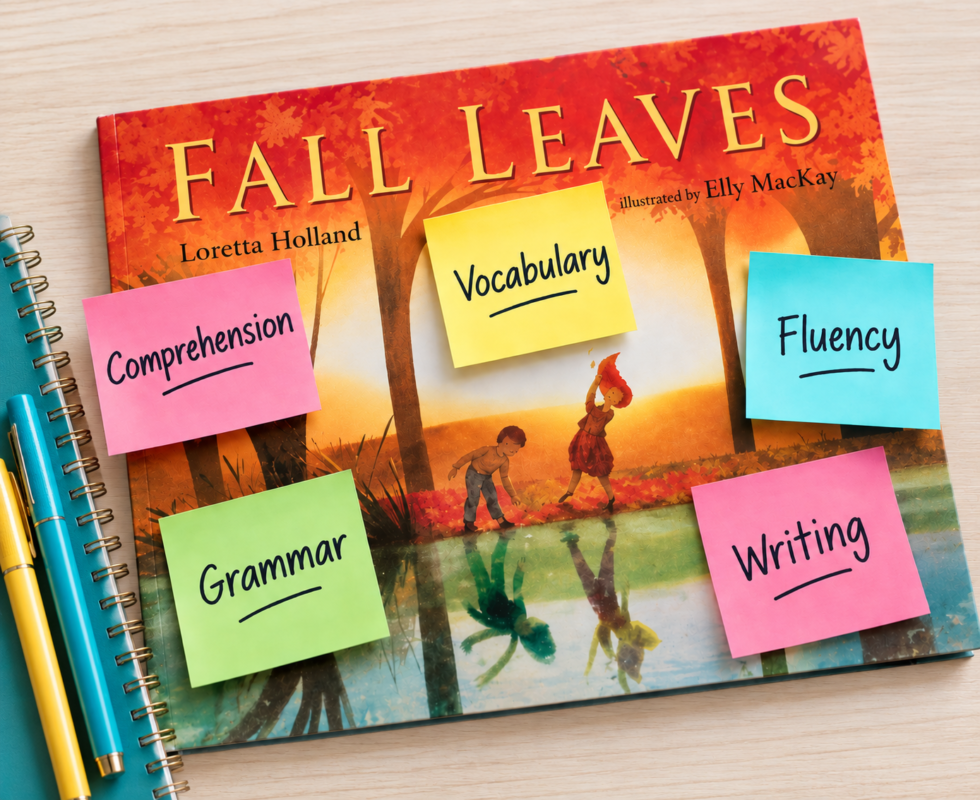
Truly, the interactive read aloud really does do just about everything. Not only can we practice deep comprehension work, we can also teach sentence structure, visualization, fluency, and vocabulary, as well as writer moves, like the use of description to elaborate. They are also an incredible background knowledge builder. This is amplified when you use a small text set around a topic or concept to really deepen understanding and the vocabulary that goes with it.
And, just as critically, how can we get more from a read aloud without adding more to our day?
Because I know how important the read aloud is for building background knowledge and vocabulary around a topic, I tend to gravitate towards narrative non-fiction. It’s my absolute favorite genre to teach with, so that’s what I have today. The process is pretty identical no matter the genre, however.
Let’s walk through how to leverage one book for multiple lessons together. I’m just going to grab a text from my own shelf. This one is Fall Leaves by Loretta Holland. This is honest to goodness the very first time I’m reading through this book. I don’t even remember buying this one! But it’s perfect, since it is currently mid-September.
First: What do I need to know before I teach with it?
Right away, I need to consider the setting, including the time period and all that comes with it. Depending on students’ familiarity with it, I may need to first do a little more prep to help my students understand it more deeply. So I might show a quick video, do a routine like See, Think, Wonder around an image or two, or even first share a simpler book on the same topic to build a base layer of vocabulary.
With this book, the setting is pretty broad–it’s outside during a season change. The concept of seasonal change might need some prep. I may choose to first read a simple book or show a very short video about seasons changing. I live in the south, so my students may not have really experienced much of an obvious seasonal change, compared to students who live in northern regions.
With that small bit of background knowledge established, I’m ready to turn to the book.
Next: What can I get from it as a reader?
Now I read the book for myself, even if I’ve read it many times before. This one is truly new to me, so it’s easier to pay close attention to my own self as a reader. This takes a bit more effort when you’re very familiar with the book, but is still an important part of the process. I don’t even think like a child as I read. I just think like a reader.
Where am I especially interested? What parts leave me a little confused? Where do I need to pause to process or connect to my prior knowledge? Where do I slow down a bit to think about pronoun referents or otherwise complex sentences? Which places do I notice an interesting word or phrase? What am I visualizing? Where do I learn something–about the character/person/concept? What am I predicting along the way and why? Where have I gained clarification? What helped me?
All of these will lead to think alouds as I read or reread the text, or can be pulled out later, for more explicit reading lessons.
As I read, I’ll jot what I notice. This never means I plan to use every single thing, it just gives me more options. Even though I won’t use them all for teaching, jotting them down ensures I won’t lose them. The goal isn’t to squeeze every possible lesson out of a book. It’s to notice the possibilities so I can choose the ones that are most useful for my students right now.
I’d still do this process when using a text from my reading program, too. The teacher guide may offer helpful suggestions I can add in, but I’d never rely on them solely. This is work I do with every interactive read aloud.
Here are some of my noticings, as I “spied on myself” while I read this book for the first time.
Right off the bat, on just the first two pages, I realized that I will need to do a deeper dive into Earth’s place in the galaxy, how it rotates as it spins, and how that determines the seasons.
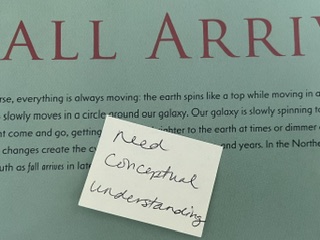
It would really benefit my students if they had seen a model of this in action so that they can better understand the text. Hopefully, I’ve already done this in science, or they’ve learned this concept in prior years, but it’s easy to do a quick demonstration of this before reading the book to my class to ensure that everyone has that foundational understanding. They’ll also need to know at least a little bit about hibernation, migration, and basic tree types.
One of the phrases that comes up is “spins like a top.” I don’t know that many kids today would know what a top is in this context, so in my demo, I’d make sure to compare the earth’s rotation to a spinning top–it should be easy to show what a spinning top is with a quick video.
Next, how can I get more comprehension work from it?
Now I’ll page back through the book, much more quickly this time, paying close attention to my questions. As I do this, I’ll keep some and toss others, as well as come up with more for discussion, especially for key points in the read aloud: before reading, during reading, and after the reading.
Later, I’ll decide which questions will be for a quick whole-class discussion, which will be great for partner conversations, which ones I’ll ask students to quickly jot about, and whether I want one or two to become bigger, Socratic seminar conversation or a longer response to reading.
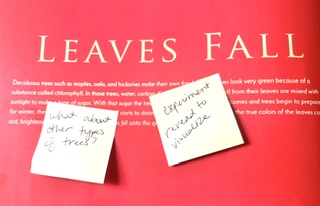
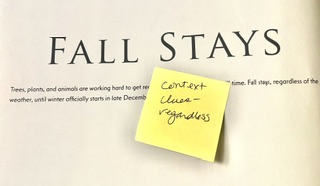
Full transparency–I have a really hard time remembering to include low-level, recall kind of questions, which I know are important for uncovering gaps in understanding. This is where I can jot these down, too, otherwise I will absolutely forget.
Some of the questions I’ll hang onto? As I page back through the book, here’s what I wrote down:
- What is it called when birds fly south for the winter?
- How do they know when it’s time to go?
- What did we learn about hibernation?
- Are deciduous trees the only ones that lose their leaves?
- What does the author mean by “carpet the woods and roads with brilliant color?” What do these word choices tell us about how the author feels about fall?
Then: What can I get from it for word work?
Well, aside from vocabulary, I might pull out some specific words to focus on decoding. There are some words in this text that students are likely to see again, especially if I’m connecting this text to science. So I might do some work with the words perennials, deciduous, produce (as in fruits), and temperature. There are many, many examples of words with affixes throughout the text, giving me even more word work opportunity.
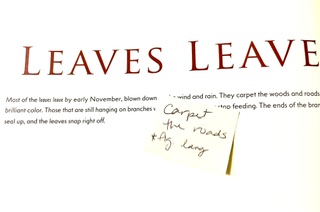
There are also examples of figurative language throughout the book. This page alone offers a couple of opportunities to talk about the meaning of these phrases.
And something that’s a rare find in a read aloud I might want to capitalize on? The words with Greek and Latin roots: chorophyll and deciduous. A great way to teach these word parts in context!
Now: What can I get from it to teach writing?
I look for all kinds of things: complex or interesting sentence structures, figurative or especially descriptive language, the author’s use of dialogue, and, depending on the text, how they’ve organized it. All of these are perfect for writing lessons.
In this book, the sentence variety is huge. There were quite a few examples of compound and complex sentences. I noticed that a variety of conjunction words are used. There are a plethora of sentences that use commas in different ways. For emphasis, the author uses italics. The text structure is clearly chronological. The author really plays with the word “leaves,” making for a great discussion of word choice. There is also a fantastic mix of descriptive words and phrases. Throughout the book, there are comparisons, appositives, and verbs and adjectives to help the reader visualize and comprehend.
The author was very deliberate in her descriptions so the reader could understand concepts. She clearly had her audience in mind, as in the section that describes earth’s rotation at the very beginning of the book.
All of these things are perfect for teaching writing lessons.
And one final look: What can I get from it for teaching fluency?
Those complex sentences give me an additional teaching opportunity: fluency. The punctuation directs the reader to phrase and pause in specific places. I could pull some sentences out to teach into phrasing and intonation. This is also how I can relate what I’m teaching students about commas in a list versus in compound sentences. Because some sentences also include italicized words, I can teach how we might stress certain words–a natural way to teach prosody, an important part of fluency.
At this point, I have a pretty long list of possibilities. But that doesn’t mean I’m going to teach all of them.
I look at my students, what we’re currently working on, and what they need reinforced, and what they need next. Then I choose the few things that will have the biggest payoff.
I’m not trying to wring every possible lesson out of a book. I’m just trying to find the right lessons hiding inside a book I’m already going to read.
That’s the point of all this noticing.
Teaching literacy is a lot. But it doesn’t have to be so complicated, and it doesn’t have to be disjointed.
The interactive read aloud is one of the most powerful tools we have. One great book can help us teach comprehension, vocabulary, word work, writing, fluency, and background knowledge. We just have to learn to look at the book through more than one lens.
In the words of Molly Ness, author of Read Alouds for All Learners (2024), “a well-conducted read aloud is elegant in its simplicity–all teachers need to start is a student, an adult reader, and a beloved text. Despite simple inputs, the outputs are extraordinary at an interdisciplinary, holistic level–cognitively, social-emotionally, developmentally, and linguistically.”
That’s a pretty powerful tool to have sitting on your bookshelf, wouldn’t you say?
Want to try this with a book from your own shelf? Download my free guide to planning reading and writing lessons and start getting more from your read alouds.

Who is Coach from the Couch? I’m Michelle Ruhe, a 25+ year veteran educator, currently a K-5 literacy coach. I continue to learn alongside teachers in classrooms each and every day, and it’s my mission to support as many teachers with this hard work as I can.
Join me in my free Facebook community–a safe, supportive environment where you can safely ask questions, get teaching tips, and share your thoughts!

Add A Comment