
Are Your Grammar Lessons Going Nowhere?
It’s an understatement to say that poor basic grammar stands out as a big need for kids today. You see it every day–a student shows you their work, and you struggle to get through it because it’s riddled with incomplete, unclear sentences. It’s one of the reasons teaching writing is so hard–not only do we have to teach the writing process and all that goes into it, now we have to focus a lot of effort on improving students’ sentences so that they’re grammatically correct. Why is grammar so hard for kids? And what can we do to help them actually apply the grammar lessons we teach?
First, it can help a lot to understand why it’s so hard for students to write in a way that’s grammatically correct.
Here’s what I see:
Screens reward short, incomplete language
Kids spend a ton of time on screens, playing games and communicating through texting abbreviated phrases using the minimum of characters. They use shortcuts for words like emojis and letters that represent words, like “u” for “you.” Capitalization and punctuation is mostly nonexistent.
Fewer rich conversations
A very unfortunate by-product of all that screen time is less time actually conversing with each other. Look around the next time you’re at a restaurant. You’ll no doubt see families whose kids–even toddlers–have their noses buried in a screen, not having any conversation with anyone at the table. You might even see parents themselves deep into their own screens, so their kids aren’t even hearing full sentences being spoken around them.
Limited exposure to full sentences in what they read
If students read on their own, it’s more often than not a graphic novel. Many of these also include phrases or one or two word back and forth dialogue with no punctuation. While engaging, these books rarely model complex syntax.
Minimal expectations for speaking in complete sentences
Both at home and in school, kids are rarely asked to speak in complete sentences. So often, we call on a child to respond, and we accept that one- to two-word answer and move on.
In short, kids just aren’t getting much exposure or practice with full sentences.
We know how important it is that kids’ oral language skills are well developed so that they can apply those same skills to reading and writing. In other words, if they can’t say it, they can’t write it. And if they don’t have much exposure to these kinds of sentences, not only can they not write complete sentences, they will also have a harder time understanding these kinds of sentences in the academic reading we ask kids to do in school.
The skill gap is wide.
Which is why a few grammar lessons here and there across the year in ELA will never be enough.
If students aren’t hearing, speaking, or reading complete sentences, then the only guaranteed place they can develop them is in school. That’s why our instructional choices matter more than ever.
While we can’t control a thing that happens at home, we can take steps to improve things at school. Here are some things we can do:
Require Complete Sentences All the Time—Orally and in Writing
Insist that students respond in complete sentences. They might need you to help them out with a sentence starter or even echo your model at first, but this is an important first step. This goes for both oral responses and written. Even answers to story problems in math offer another opportunity to write a clear and complete sentence.
Increase Conversational Turns
Take a cue from the authors of Strive for Five, and push students to say more by pushing for more conversational turns in any verbal exchange. Asking them to say more asking a question to elicit a deeper response is a very simple way to push for more turns of the conversation.
Provide More Complex Text Exposure
Be ok with mixing in some assigned text for reading. Kids usually gravitate toward graphic novels because of their simplicity, but exposure to more complex sentences, plots, vocabulary, and concepts is also very much needed. If we don’t provide more complex texts more often, students will likely never get the practice they need.
Stop Teaching Grammar Lessons in Isolation
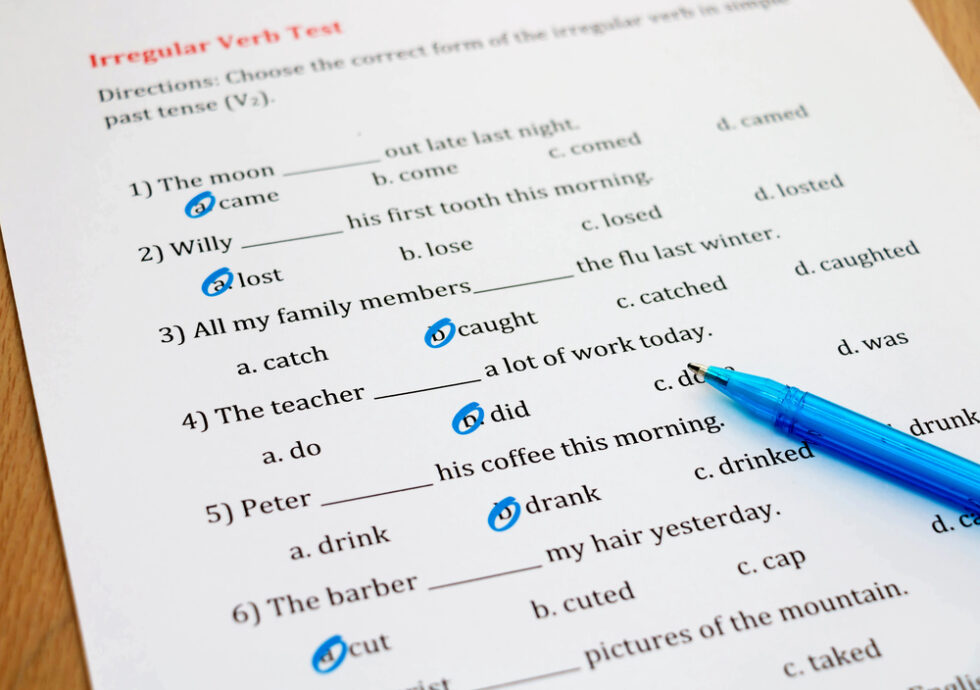
Avoid isolated grammar activities. They just don’t transfer. The research on this has been loud and clear since the 1940s and has continued since then. (See Macauley, W.J., 1947). Back in 1996, Constance Weaver wrote a very comprehensive book all about teaching grammar, in her aptly titled book, Teaching Grammar in Context.
Many books since then have been written about this, including Mechanically Inclined, Wondrous Words and Not Your Granny’s Grammar. Each one talks a great deal about the reason why isolated teaching of grammar, outside of the context of real reading and writing, does not transfer.
Use Read Alouds and Shared Reading as Examples of Grammar in Context
Pull out examples of sentences from the interactive read alouds you’re already using, and model writing them. I go into detail about this in a previous post. Use shared reading to highlight examples of sentence structures, model reading them fluently according to the punctuation, and have students chorally read them together. All of these exposures allow students that much more opportunity to hear, read, and write in grammatically correct ways.
Leverage Small-Group Reading for Sentence Work
As well, get more out of the texts you’re using in small group instruction. These texts are a great way to show how different sentence structures work, and offer students the opportunity to both hear and read them. This is a great way to use leveled texts, as the degree of sentence complexity increases slightly from level to level.
Teach Grammar Lessons All Day, Not Just in ELA
Remember that grammar instruction can and should happen all across the day. Few and far between grammar lessons relegated to only the ELA block will never be enough, especially given the deficits we’re seeing in what students produce. This is big work and it takes time, which is only compounded by the reasons I outlined at the beginning of this post. This is exactly why the authors of the Writing Revolution preach that this work should happen inside of content classes, too.
The truth is simple: if students aren’t hearing, speaking, reading, and writing grammatically correct sentences on a daily basis, those skills won’t magically appear.
Grammar won’t transfer from worksheets. It will transfer from meaningful practice in real reading and writing.
As teachers, we can close the gap—not by adding more to our plates, but by teaching grammar in the places it naturally lives.
This is the work that pays off. And our kids need it now more than ever.
We may not be able to change what happens at home, but we absolutely can change what happens in our classrooms. And it starts with small, consistent moves that build the sentence skills kids need to thrive.
If you could use a thinking partner to help you think of ways to include meaningful grammar lessons into your week, I’m here to help! Through virtual coaching, I can help you figure out ways to sneak in grammar instruction in meaningful ways from the comfort of your living room! Just email me at michelle@coachfromthecouch.com to set up a coaching call!
Did you find this post helpful? By all means,share it with a teacher friend so they can benefit, too!
And, be sure to join my Facebook community–a safe, supportive environment where you can safely ask questions, gain ideas, and share your thoughts among other literacy-loving educators!

Who is Coach from the Couch?? I’m Michelle Ruhe, a 25+ year veteran educator, currently a K-5 literacy coach. I continue to learn alongside teachers in classrooms each and every day, and it’s my mission to support as many teachers as I can. Because no one can do this work alone. I’m available to you, too, through virtual coaching calls!


Add A Comment