
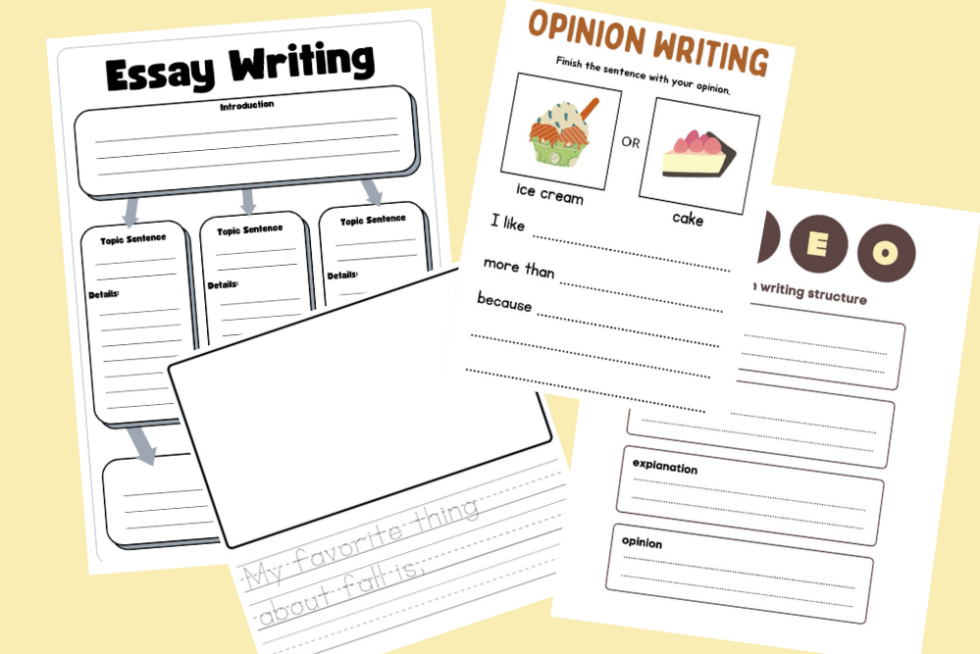
Before You Hand Out That Writing Template…
There’s no question about it: writing is hard for kids. Which, let’s be honest, can make it hard to teach. Knowing this, teachers often begin with having kids use a writing template. While this type of graphic organizer can be helpful, it can also obscure our view of what our students are really capable of. Worse, these sorts of writing scaffolds can even hold them back. Let’s talk about how to know when it’s time for students to use them and when it’s not.
First, some real talk.
Often, when you look at student writing, you see spelling and punctuation mistakes galore, incomplete sentences at every turn, and details that don’t quite hit the mark. You think there’s so much to teach them, they cannot possibly write anything on their own. That’s when many teachers gravitate toward a scaffold like a specific graphic organizer or provide students with sentence starters…or even both.
Or teachers will try to prevent this from happening at all, and assume that students will need the high level of support these scaffolds offer. In this case, teachers supply students with templates right from the get go. Usually, all students get the same template.
Scaffolds can be extremely helpful. They can give kids an on-ramp to the complex task that writing is. They can reduce the cognitive load that writing entails, which allows for confidence to build. We all need some good writing templates in our toolbelt.
But here’s the thing. Templates and sentence starters are scaffolds. Meaning they are used as needed and are not permanent.
Before we provide a scaffold like a writing template, we first have to see what our students can actually do.
If we lead with assumption rather than data, we might overdo it or miss the mark. We might even try to teach too much too soon. Every group of students is different, so we cannot assume that this year’s group is what last year’s group will be like. We must meet them where they are.
How?
To begin, it’s always a good idea to show students examples of the kind of writing you’re about to do before even asking them to put pencil to paper. Giving them a picture of where they’re headed can go a long way. It’s a way to help kids understand how a particular kind of writing is organized (among many other aspects). Graham and Harris, developers of the highly effective, original SRSD (Self-Regulated Strategy Development) intervention, advise beginning with this important step. This may even be scaffold enough for some students!
You might even take this a step further, depending on your grade level and students’ experience with writing, and examine these examples together, as a class, against the criteria you’ll be using to measure student work later. Pulling out the rubric or checklist now, before students write, gives them an even clearer picture of the road ahead and gives them the language behind it. For example, if you want students to incorporate transitional phrases in their writing, pointing out what that looks like in the examples helps to provide a clear definition of what “transitional phrases” means.
This powerful work also sends the message to students that you’re setting a high bar–and that you know they can reach it.
For shorter pieces of writing, and for younger students, using shared writing to model the kind of work you’re about to ask students to do before officially asking kids to write in the same kind of way is another opportunity to crystallize the goal. Jessica Carey, of Two Writing Teachers, beautifully sums up the power of this practice when she says, “Starting a unit with shared writing helps students see the process, practice the craft, and approach their own writing with clarity and confidence.” This immersion into a new genre of writing, whether it be just a summary or response to reading or a full piece, is key for students.
Now it’s time to see what they can do.
Ask them to write.
Without handing them a template, graphic organizer, or sentence starter yet.
Without holding their hand. Just see what they can do.
When you sort through their writing after this immersion phase, you’ll very likely see that some students are right on track, and only need support in making their writing stronger, some are nearly there, and some are truly on the struggle bus. This will tell you how to adjust your teaching.
It’s also how you will know who needs a scaffold and how heavy it needs to be. Assuming everyone needs the same level of support before even watching to see what they can do would mean holding some back–and cost you precious time. Assuming everyone needs high levels of scaffolding right out of the gate also assumes students have held onto nothing from previous years.
After teaching a writing unit–whether that’s something short or long–it’s important to see what kids can do again. Without your help. This unassisted look at what students know how to do is the truest reflection of how well your lessons have landed. As Anita Archer has famously said, “how well you teach = how well they learn.” Take copious notes while they write. Note what they do to get started, whether or not they’re taking time to plan, what they do to get “unstuck,” and whether or not they do anything to revise before calling it done.
This is how we know what sorts of support different kids might need next. It’s also a mirror of our teaching.
If students can’t…
- Get started
- Plan/organize without being handed a template
- Read back their own writing (primarily K/1)
- Apply the things we’ve spent a lot of time teaching
- Self-check on some level to revise/edit
…then it’s a sign they’ve been overscaffolded. They’ve become too reliant on the supports and haven’t had enough of a nudge forward to become more self-dependent. As well, if you’re not seeing improved work from piece to piece, this is a sign there may have been too much hand-holding.
The goal is for students to self-start. To know the process. To have the confidence to know what to do.
We want kids to put in the work. To think. To try. This is productive struggle at work–an important factor in learning.
“People should not be scared of difficulty. It’s part of our duty to young people to help them understand how to struggle and actually be gratified in the end that they persisted.”
Doug Lemov, Melissa and Lori Love Literacy podcast
It’s the whole premise behind Think SRSD. The “SR” stands for “self-regulated,” so the goal is to empower students to be able to use the tools from our teaching on their own. This might mean they know how to set up their own organizer. That they know what to look for when they revise and edit. And that they have the confidence in knowing they can.
Paired with the conferring feedback you’ve given them along the writing process, this snapshot of what your students can really do is your guidance for the next round of writing. Maybe they do need greater scaffolding. Maybe they need less, or a different kind. Maybe they’re ready for next steps. Depending on the proficiency you see, maybe they no longer need these scaffolds at all–because self-regulated writing is the ultimate goal.
Writing will always be challenging—for our students and for us.
It is, after all, one of the most cognitively demanding tasks students will ever do. It takes courage to let kids struggle, and patience to help them find their way. But that’s how writers are made. It’s in that productive struggle that students grow the most. When we give them models, space, and trust, they surprise us every time. So next time you’re tempted to hand out that graphic organizer right away, wait. Watch. See what they can do first. When students move from relying on us to relying on themselves, that’s how we know that real learning has taken place.
Our ultimate goal isn’t perfect, polished writing—it’s confident, independent thinkers. When students learn to regulate their own process, they’re not just figuring out how to write; they’re figuring themselves out as learners. That, to me, is the real measure of success.
Could you use a thinking partner to help you plan writing lessons that support your students yet don’t hold their hands too much? I’m here to help! Simply email me at michelle@coachfromthecouch.com or reach out for a coaching call.

Who is Coach from the Couch?? I’m Michelle Ruhe, a 25+ year veteran educator, currently a K-5 literacy coach. I continue to learn alongside teachers in classrooms each and every day, and it’s my mission to support as many teachers as I can. Because no one can do this work alone. I’m available to you, too, through virtual coaching calls!
And, be sure to join my Facebook community–a safe, supportive environment where you can safely ask questions, gain ideas, and share your thoughts among other literacy-loving educators!


Add A Comment