
When Your Curriculum Lesson Plans are Too Much
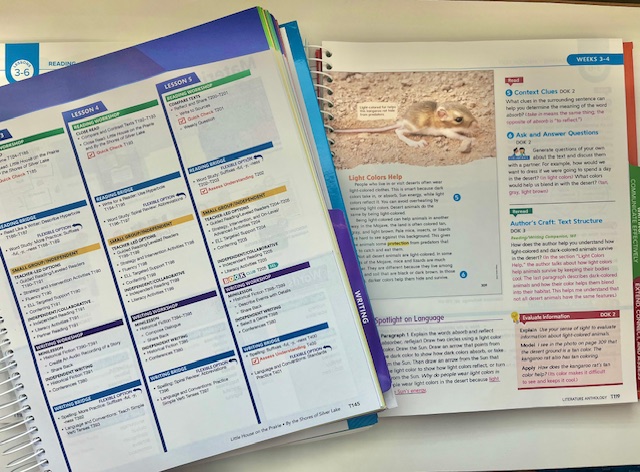
It’s very common to hear the term “curriculum bloat,” otherwise known as “basal bloat.” Curriculum companies want to sell their product to as many districts in as many states as possible, so they add in as much as they can in order to sell more product. This is why, if you’re using a program, even just paging through the lessons feels exhausting. Often, the time allotments the curriculum companies suggest are not even possible with the time you actually have. You likely couldn’t even get to it all even if the ELA block were doubled. This also means following the scripts as written would keep your teaching at only the surface level. What can you do, then, when the as-written curriculum lesson plans are just way too much?
First, it goes without saying that we must go into it with the understanding that no curriculum on the planet is perfect.
Which is why the whole notion of “teaching it with fidelity” is a big mistake. The “bloat” is real. It’s been likened to a truckstop buffet, where there’s so much available, it’s all too easy to make bad choices. It’s hard to “cut the fat” and get to the true meat and potatoes, as explained in this review from Curriculum Matters.
Then, it’s a matter of stepping back to really evaluate what’s good, what’s missing, and what needs some tweaking. This is where our teacher expertise is so important. Some programs include way too many disconnected texts. Some completely separate reading from writing. Some don’t include writing at all. Heck, I know one program that doesn’t even teach reading skills at all…it only assesses content understanding.
Most programs also go way too fast, expecting students to build background knowledge, learn new vocabulary, listen to and/or read a large amount of texts, complete grammar lessons, and take an assessment–all in one single week!
It’s way too much–for both students and for teachers.
There are many ways to boil down to what’s most helpful in a boxed curriculum. One easy way to both cut down on “all the stuff” and strengthen learning for students?
Reduce the amount of texts you use in a week.
Many curriculum program lesson plans include a large variety of texts. Too many to truly do justice with in a week. The aim is to provide a text set in order to build knowledge, but this can still easily be done by anchoring to just one text per week. Ensuring that all of the texts you choose are in fact tied together to build understanding around a topic or enduring question is still, in fact, a text set.
Why this works better:
- Some programs include texts that are too dense, too complex, or even just not appropriate for the age level. Filtering these out goes a long way in reducing the bloat.
- Honing in on just one text per week means you can spend more time on it. Which means you can then deepen the vocabulary work and use parts of the text for strong grammar and conventions lessons that are grounded in authentic text.
- Spending more time in one text means you’re much better able to build in an I do, we do, you do model. Some of the text can be read aloud so that you can model thinking strategies, some can be read together in a shared reading format, and students can read some of it with partners and/or independently.
- Because slowing down means more time is then available for shared/choral reading, this gives you a chance to truly teach lessons in fluency, and gives kids much more opportunity to actually practice fluency with your feedback.
- Something that’s sorely missing in almost all curriculum programs is time for discussion. When we take away the rush to “cover” all the texts in a program, we open up much more time to linger on a text. This is where we can really discuss author’s purpose, author’s craft, meaning, and theme.
- When we make room for these deeper discussions of author’s craft,word choice, text structure, sentence structure, and the like, we’re naturally creating mentor texts for writing. This is a very powerful beginning step in showing students how to write in a particular genre. There’s absolutely no need for yet another text to use for this purpose like some programs include.
- Sometimes, it can be better to scrap the excerpts and opt for the entire real book instead. One single text, then, could be read across the entire unit, serving as material for both reading and writing lessons.
- This requires careful alignment, but another idea is to bring some of the reading program texts into your social studies and science classes. As many boxed curricula now aim to “build knowledge,” it makes sense to augment the content you’re already teaching with additional texts for deeper understanding. This is one way to deepen conceptual understanding, and it’s also a way to integrate literacy across the day.
One of the most important things we make room for when we reduce how many books we try to get to in a week?
Independent reading.
If we take up all the available time in our ELA block with whole group reading lessons, there’s little to no time left for kids to actually apply the skills we’re teaching them. We certainly cannot expect them to practice at home. According to NAEP, today’s students’ home reading is “at the lowest levels since at least the mid-1980s.” As students read less and less outside of school, it’s up to us to ensure that they have the opportunity while they’re with us. We must make space for independent reading!
Careful text selection of the many options available helps us make that space. And it results in so many other benefits. It’s all about slowing down and using our expertise to be more intentional with what we’re already using. This allows us to teach more deeply, respond more thoughtfully to students, and reconnect reading, writing, discussion, and fluency in more meaningful ways.
It’s not about abandoning the program. It’s about recognizing that a boxed program is a resource. The program provides possibilities, but teacher expertise determines priorities. When we reduce the bloat, we make room for the things that matter most: sustained engagement with text, authentic talk, purposeful writing, and time for students to actually read.
Cutting back isn’t about doing less. It’s about doing better with what we already have.
And by the way, if you could use a thinking partner to help you figure out where to cut curriculum bloat for more intentional, time-saving teaching, reach out! I’m here to support you in this complicated, messy business of literacy instruction. Because no one should have to do this work alone!
Was this post helpful? Subscribe here to be the first to see new posts that will make an impact on your teaching!
For ongoing, quick support, about writing and ALL things literacy, join my private FB group! It’s a community of educators just like you to offer support right when you need it.
Who is Coach from the Couch?? I’m Michelle Ruhe, a 25+ year veteran educator, currently a K-5 literacy coach. I continue to learn alongside teachers in classrooms each and every day, and it’s my mission to support as many teachers as I can. Because no one can do this work alone. I’m available to you, too, through virtual coaching calls!



Add A Comment