

What Literacy Teachers Really Need (It Isn’t More Trends)
As a teenager many moons ago, one of the questions I remember my parents asking me the most was if so-and-so were to jump off of a cliff would you follow them? Always, the answer was (or was supposed to be) no. At which point, my mother would look at me, eyebrows raised, with an expression that meant one thing loud and clear: I should make my next decision very carefully. It caused me to pause, reflect, and think through potential consequences. And, being a teenager, I often followed the crowd anyway, consequences be damned.
I see this same thing happening all the time in literacy instruction. There’s a lot of following literacy trends instead of building the knowledge to evaluate them. There are so many examples of educators diving in headfirst, only to find out later, whether through research or experience, that it actually was not the way to go. It’s happening at an alarmingly rapid rate right now.
For instance:
- Just a couple of years ago, focusing on isolated phonemic awareness instruction was all the rage. Not long after, integrated awareness instruction that connects to phonics proved to be the way to go.
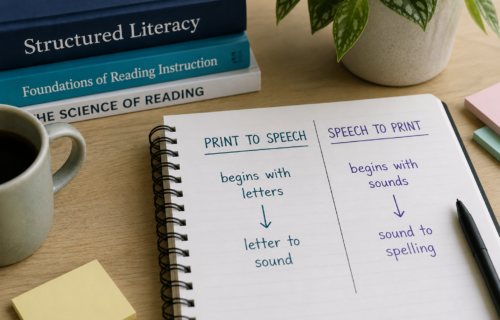
- Phonics has been the hot topic for several years now. At first we heard all about print to speech approaches, but now we’re hearing more and more about speech to print, with no real determining factor to point to what’s actually best, as was the case nearly thirty years ago with the National Reading Panel report.
- We’re hearing that small group instruction is very necessary, but we’re hearing that it’s a waste of time. I talked about this in a previous post.
- Programs across states were purchased and implemented at great cost, yet have not proven to be the silver bullet legislators were hoping for. (Daily News)
- iReady and programs like it are proving to be ineffective (or worse). (The Digital Delusion)
It can make anyone’s head spin, and this is not even close to an exhaustive list.
So much back-and-forth. So much push and pull. And it all leads to massive confusion.
So what is a teacher to do? How is a teacher to know which approach to take?
There’s no easy button for this answer, much as we all wish there were.
For one, it must be acknowledged that when state, district, and/or school leaders dictate the moves teachers can and cannot make, it complicates things considerably. When programs are scripted, teachers don’t always have the flexibility to respond to students.
Even in instances where we see that programs are clearly lacking, these mandates don’t allow us to be as responsive as we’d like.
As large as this barrier can be, there’s an even larger reason it’s not so easy to know what to do. Because even within these kinds of mandated constraints, it’s professional knowledge that matters most. The kind of knowledge that helps you decide when to follow a program and when to pause and adjust based on the students in front of you.
This is deep professional knowledge.
Hard-earned knowledge learned over a long period of time. Which means gaining knowledge from differing schools of thought, not echo chambers.
It means understanding that we’ve been here before, and why it’s always gone south.
It’s not about following the crowd off a cliff, which is happening all the time lately. People jump off the cliff of the new flavor of the day, whether by mandate or by choice, and seem to forget all about past research, insights, and experience.
What it all comes down to, in the end, is deepening and widening our own knowledge and understanding. It’s that simple.
But it’s not such a simple thing to actually do.
It takes time to get there.
It’s about not layering knowledge like sedimentary rock, with new insights covering up what we’ve already learned. Rather, it should be more like marble. The knowledge and insight that we learned before shouldn’t be left behind. That understanding still matters.
Instead, the new insights we gain should blend with prior insights, not obscure them. It’s about synthesizing, not replacing.
It means, as Lester Laminack so beautifully puts it, “As a profession we understand that how we teach, what we teach, what we think about should be, like any other professional practice, ever evolving, ever-changing as we continue to question and research and refine.”
Why? Because there is no “one way.”
Understanding what the readers in front of you need goes beyond the Simple View. Beyond the Reading Rope. Heck, it goes beyond just reading models. We also need to have a deep understanding of writing instruction, and how it connects to reading. We need to understand how to apply “the science of learning” and how to motivate students in real ways. And that’s just a start. It’s a lot.
The answer is always that it depends on what kids need. Always. Which means, in order to be responsive, we need deep knowledge.
There is no quick fix. There’s no program that does it all. No holy grail book or professional development.
It’s about continuous, relentless learning. Refining our practice. Leaning from and with each other. It’s about getting and staying curious. Watching how kids respond and responding to what they need.
Was this post helpful? Subscribe here so you don’t miss any new posts!

Who is Coach from the Couch?? I’m Michelle, a 25+ year veteran educator, currently a K-5 literacy coach. I continue to learn alongside teachers in classrooms each and every day, and it’s my mission to support as many teachers as I can, because no one can do this work alone–especially with all the back and forth about literacy instruction going on at the moment.
Through virtual coaching calls, I’m available to you, too. I absolutely love working with teachers around the country to solve their literacy puzzles! Simply email me at michelle@coachfromthecouch.com or reach out for a coaching call!
Or, consider joining my Facebook community–a safe, supportive environment (really–no blaming or shaming allowed!) where you can ask questions, learn ideas, and share your thoughts among other literacy-loving educators!


Add A Comment