

Sneaky Ways to Teach More Writing
More and more (thankfully), there is a cry for greater focus on writing in today’s classrooms. The reason most often cited? That NAEP writing scores are even lower than reading. But there’s a far bigger reason writing needs much more attention–the impact that writing has on reading achievement. This is something that’s been proven for decades, yet schools tend to focus so heavily on reading that writing gets pushed aside.
The reason for this? There are several, but mostly it’s time. Because reading instruction takes so much time, writing continues to be neglected. I get it. The school day is crazy busy, and the ELA block is far too short for all we need to fit in. So, this post is all about helping you find sneaky (and painless!) ways to teach more writing.
Every bit of attention we can dedicate to writing will greatly improve student skills.
Sneaky Idea #1
To really get writing instruction right, we must give it about as much time as reading. But when the day is short and the curriculum is long, this can feel impossible. That’s why combining reading and writing lessons into just one streamlined, efficient (and powerful!) lesson is the way to go. There is much research to support this approach, too. Reading and writing are two sides of the same coin, so connecting the two just makes sense. Not only does this enhance student learning, it also opens up a ton more time in the ELA block so kids have more time to write (and read) and you have more time for conferring and small groups. A recent Education Week article sums it up well, saying “research suggests that teaching students to write in an integrated fashion with reading is not only efficient, it’s effective.”
“Much like the body of knowledge on how children learn to read words, it is also settled science that reading and writing draw on shared knowledge, even though they have traditionally been segmented in instruction.”
Education Week, January 17, 2023
Because this isn’t a model that we’re used to, it can be hard to wrap your mind around how it works. Check out this post for an overview, or learn the steps in this micro course I created. Once you get going with a model like this, even just a couple days a week, you’ll never go back to time-constrained, siloed instruction again!
Sneaky idea #2
Teach more writing in content area classes.
Here’s the deal. If someone declares they want to eat healthier to lose some weight, they don’t only choose healthy foods for their afternoon snack. It would get them nowhere if the rest of the day they ate junk. Instead, people who want to eat healthier choose healthy foods all day.
This is exactly the same thing that happens when writing is left to a tiny slice of the day. If you’ve ever lamented the fact that your students’ writing is riddled with grammar and convention errors, then you’ve seen this. If we only instruct students in writing for a small percentage of the day (and too often not even every day) but the remainder of the day is never connected to writing, we cannot be surprised that they don’t hold onto what was taught.
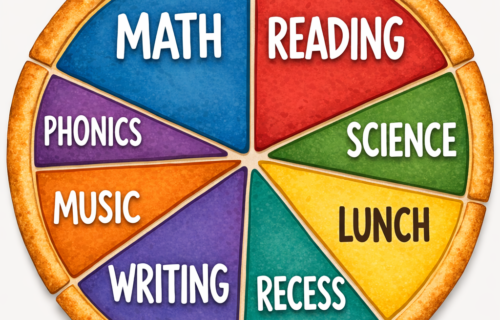
That’s why it’s imperative that more writing is woven in throughout the day. It should become normal practice to write all the time. This is the entire premise of The Writing Revolution, and ample research backs it. Shanahan (April, 2022) writes about this, saying that “Studies continue to accumulate showing that combining reading and writing can enhance learning, particularly when these combinations are carried out in content areas like history.” This is true of elementary, intermediate, and secondary students.
Sneaky Idea #4
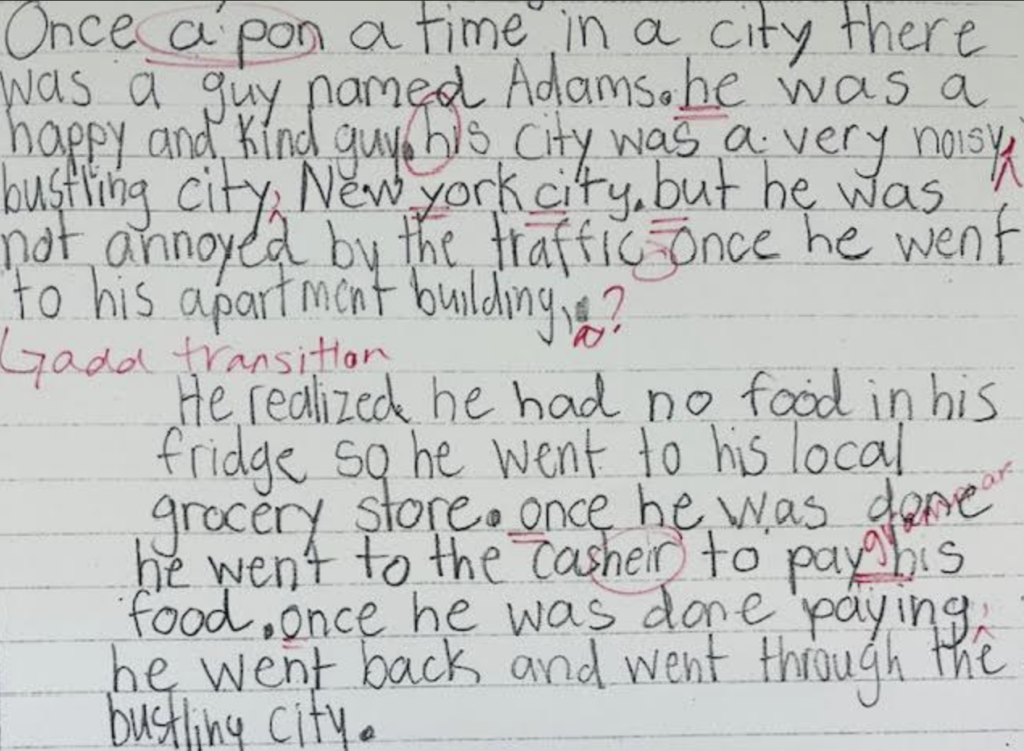
Tightly tied to weaving writing throughout the day is holding kids accountable throughout the day. Did a student turn in homework with missing capital letters and punctuation? Hand it back, with the expectation that it must be fixed. Did you notice a bunch of run-on sentences on a quiz (or any other piece of writing)–even though you just went over this last week? Again, hold them accountable. Do not just sigh or shake your head. Hold them accountable!
If we only hold kids accountable for the things we want to see in their writing during the time we’re teaching it and don’t hold them accountable all the other times, we’re just reinforcing bad habits. And these kinds of things are habits. It takes a lot of practice, a lot of application, over and over and over (with your feedback!) to really solidify to the point of automaticity.
Sneaky Idea #5
Quick writes!
There are many ways to incorporate quick writes. A common one is to show an image and have students write a quick story to explain what’s going on. Sort of like that Caption This game, but with more writing. Students love this type of free write. Robin Holland, a phenomenal Ohio professor I had the incredible luck to learn from, wrote a wonderful book all about powerful quick writes (great for upper elementary all the way up).
Morning meeting can be another time for a quick write. This could be as simple as write a letter to yourself to tell how today will be a great day or write a compliment to a classmate (or themselves).

Brain breaks are another easy time for a quick write. Possibilities are endless, but some ideas: write a funny story in 3 minutes, write a silly story in 3 sentences, describe the strangest animal you can imagine, or invent a new sport and explain the rules.
Consider ending the day with a quick write. This can be a great way to slow the backpack-grabbing stampede that can happen right before dismissal and create a calm atmosphere before leaving for the day. Students might write one thing they learned that day (which will help jog their memory when mom asks the same question in 15 minutes), one thing they’re proud of themselves for, or something that made them smile that day.
As always, do not let grammar, conventions, or punctuation slide. Remember that every writing opportunity is an opportunity to practice correctly. But that also means lots of incorrect practice makes for incorrect habits.
Sneaky idea #6
Add more writing to what you’re already doing. At the early levels, ensure that students are writing the letters as you practice phonemic awareness. Research abounds that this is best practice, and it takes no extra time. Make your interactive read aloud time more interactive and add in more writing. Again, the possibilities are limitless here, but here are some examples: write a thought bubble to describe what a character is thinking, write a prediction partway through the text, jot a quick 3-sentence summary of the text partway through and/or after the book.
Time absolutely must be made to teach more writing.
There’s no question about that. Writing is a complex cognitive task with many layers to it (see The Writing Rope for more), and that takes intentional, consistent time. And because writing does so much for comprehension. After years of research, Graham and Hebert report that “teaching students how to write improves their reading comprehension, reading fluency, and word reading” and that “increasing how much students write enhances their reading comprehension.” (Harvard Educational Review, 2011)
Hopefully this post has helped you see that doing more writing won’t take up more time than you have. With a little more intentional planning, we can sneak in more writing all across the day. If every teacher did that–along with continuously holding students accountable for what’s been taught–year after year, I have no doubt that not only would NAEP writing scores see a tremendous increase, but so would reading scores.
And as students’ skills improve, teachers everywhere would have a much easier time teaching writing.
If you could use some help finding ways to add in more writing across the day, I’m here to help Just reach out for a coaching call!

Who is Coach from the Couch?? I’m Michelle Ruhe, a 25-year veteran educator, currently a K-5 literacy coach. I continue to learn alongside teachers in classrooms each and every day, and it’s my mission to support as many teachers as I can. Because no one can do this work alone. I’m available to you, too, through virtual coaching calls!
Or, consider joining my Facebook community–a safe, supportive environment (really!) where you can ask questions, learn ideas, and share your thoughts among other literacy-loving educators!


Add A Comment