What’s the Difference in the Two Phonics Approaches?
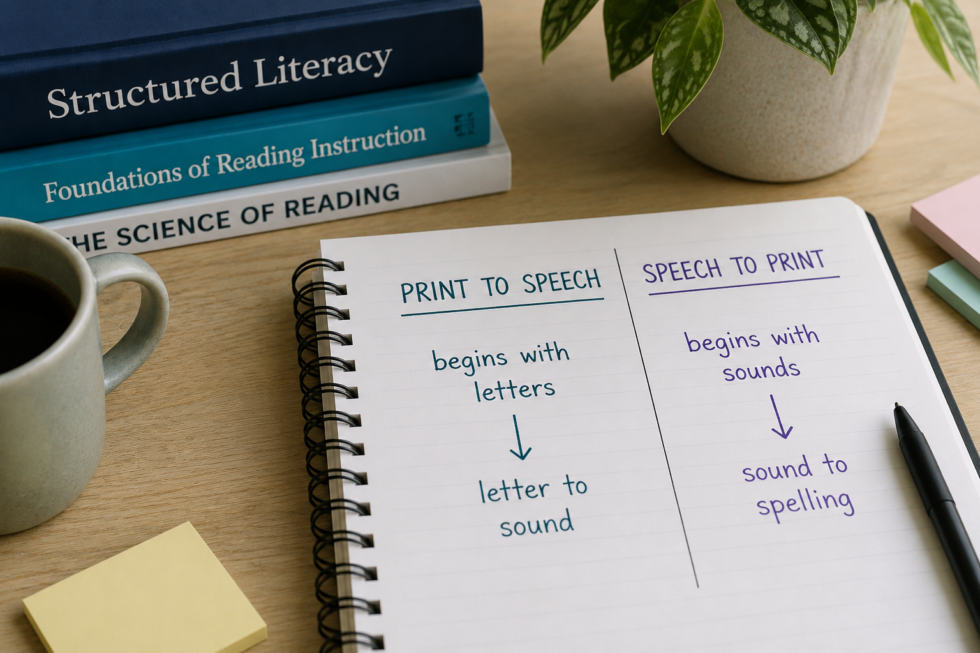
There are, primarily, two approaches to phonics instruction. In simplified terms, they are print to speech and speech to print. Which begs the question…which of these two phonics approaches is best?
Great question. Let’s dig in.
In a print to speech approach, individual graphemes and their corresponding phonemes are taught, whereas in a speech to print approach, the phonemes and their corresponding graphemes are taught. In other words, the former starts with letters and connects them to sounds, while the latter starts with sounds and connects them to spellings.
Clear as mud, right? Let’s do a deeper comparison for some clarity.
First, how they’re alike:
Both phonics approaches are very systematic. They follow a very similar scope and sequence of letter-sound correspondences that move from least to most complex. Both include a lot of encoding and decoding. Students read and write at the word, sentence, and text level using current and previously learned phonics patterns. Decodable texts are a key component for both approaches to instruction.
Programs for both approaches expect that students are highly involved in the lessons. And both involve explicit instruction, although the degree of explicitness ultimately depends on the teacher. This makes a significant difference.
Both approaches work well across the different tiers of instruction. They can work equally effectively when used for whole group, small group, or even one-on-one lessons.
Either way you slice it, these two phonics approaches both have great things going on. Both can be highly effective.
What’s the difference?
Print to Speech
Programs like Orton-Gillingham, Fundations, Sonday, Words Their Way, and UFLI are examples that all fall under this category.
They each introduce graphemes and the sounds they make in a gradual, carefully sequenced way, moving from most simple to most complex. Because of this, the scope and sequence for teaching tends to be lengthy and can take quite a while to get through.
With this long scope and sequence, several commonly used print to speech programs only spend a couple of days on a pattern before moving on. Sometimes these programs account for this and allocate a good deal of time the following year reviewing previously learned concepts. Aiming to build in more practice, some–but not all–print to speech programs include interleaving of concepts across lessons.
Print to speech programs are designed specifically for phonics instruction. Which of course makes perfect sense. However, in the programs I’ve seen, there isn’t clear guidance on how or why what’s taught in the phonics block can be integrated into other parts of the day.
Although this sort of natural integration comes with teacher knowledge and experience, without specifically calling this out, teachers (especially newer teachers) are likely to miss these golden opportunities for practice and retrieval. Without intentional teacher planning, connections to reading and writing across the day may become minimized or even left out.
Speech to Print
Programs like Reading Simplified, Sounds Write, and EBLI are all variations of a speech to print approach. These programs introduce the sounds first, and then the graphemes that correspond to them–but as symbols, not necessarily letter names. The philosophy here is that what’s needed for reading and writing are sounds, not names of letters.
For this reason, when introducing long a, for example, the teacher would introduce multiple ways to spell long a all at once (ie. aCe, ai, ay, eigh), whereas a print to speech approach might introduce each of these four graphemes in several different lessons across a longer period of time. In a speech to print approach, reading through writing/spelling sounds is the primary teaching mechanism.
The speech to print programs I’m familiar with are often clear about calling attention to other places in the day where there is opportunity to echo or reinforce phonics instruction. It’s made clear to teachers that phonics instruction can (and should) ripple across the day, week, and months.
There’s so much more. I could go on for days about the differences and similarities between these two phonics approaches, but here’s a brief snapshot of some key comparisons:
| Print to Speech | Speech to Print |
| Begins with graphemes and teaches the sounds they represent | Begins with phonemes and teaches the spellings that can represent them |
| Instruction is led by print | Instruction is led by spoken language (sounds) |
| Often emphasizes letter names alongside sounds | Minimizes emphasis on letter names and focuses more on sound-symbol relationships |
| Typically introduces one or two graphemes at a time | Introduces multiple spellings for one sound together |
| Follows a slower, more gradual scope and sequence | Shorter, faster pace scope and sequence |
| New concepts may only be taught for a few days before moving on | More time allocated to working with a single sound and its corresponding patterns |
| Students alternate between encoding and decoding tasks within a lesson | Students usually read and write simultaneously within lessons |
| Often teaches irregular high-frequency words systematically | Typically treats high-frequency words as regular and decodable, no special attention to these words |
| Often teaches syllable types and division patterns in detail | Focuses on chunks and sounds students can hear with no attention to syllable types or division rules. |
| Programs usually aim for 80% mastery or higher before moving on | Programs often consider roughly 70% mastery sufficient before moving on |
So which is better?
The National Reading Panel had something to say about this very question back in 2000 when they published their report. When the panel compared the two phonics approaches, along with a third, differing approach, they found that “they do not appear to differ significantly from each other in their effectiveness.”
That’s right. None was better than the other. All that mattered was that phonics is actually taught and that it’s taught in a systematic way.
Both approaches have strengths and both have drawbacks. And just as with reading programs in general, any phonics program will have both strengths and drawbacks as well. No program is ever going to be perfect.
The bottom line
The goal isn’t to find the “best” program or the “best” approach to phonics instruction. It’s to understand the strengths and limitations of both so that we can respond more flexibly to students.
After all, we all know that not every student responds to instruction in the same way. Some students are fine with one approach, others aren’t. Some need something different; some need something more.
That’s why I think it’s worth deeply understanding both speech to print and print to speech approaches to phonics. Deeply understanding how the code works and how to teach it in different ways just sharpens our own toolbelt. Knowing how to employ both approaches just better equips us to meet the needs of the very diverse learners in front of us.
There’s no “winner” here. They’re just two different ways to approach the same goal.
In the end, it always comes down to teacher expertise. Our ability to understand learners, adapt instruction, and draw from multiple approaches will always be what matters most. That’s what “wins” every time.
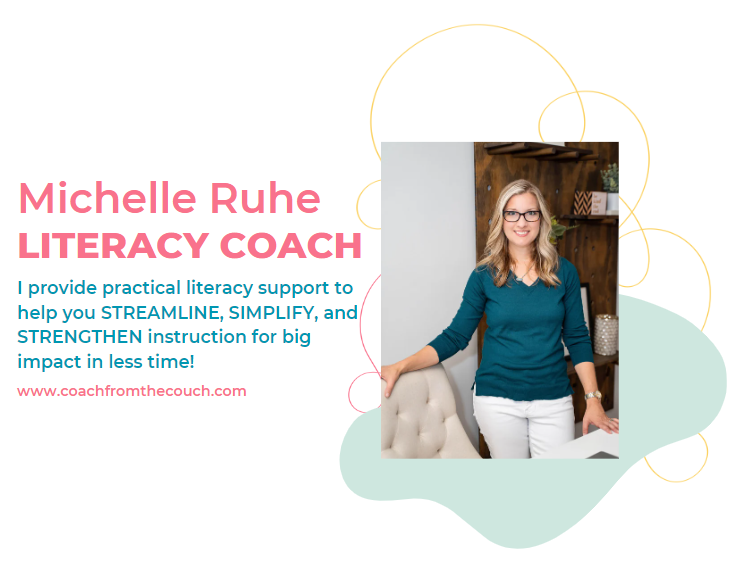
Who is Coach from the Couch? I’m Michelle Ruhe, a 25+ year veteran educator, currently a K-5 literacy coach. I continue to learn alongside teachers in classrooms each and every day, and it’s my mission to support as many teachers as I can. Because no one can do this work alone. I’m available to you, too, through virtual coaching calls!
Or, consider joining myFacebook community–a safe, supportive environment (really!) where you can ask questions, learn ideas, and share your thoughts among other literacy-minded educators!



Add A Comment