The Professional Learning Shaping My Thinking Right Now
One of the truisms about being an educator is that there’s always more to learn. Longtime instructional coach Steve Barkley says it best: “there is no apex to teaching.” That can be frustrating for some–just when you think you have a handle on something, new findings come out, a different approach comes to light, a colleague or a student challenges your thinking, or you just run into another obstacle. This doesn’t bother me. I’ve always embraced this truism, because I love to learn. And boy, when it comes to teaching literacy, it seems there’s no end to avenues for professional learning.
I’m a lot like the Laura Numeroff books come to life when it comes to professional learning. Because if you give Michelle a topic, she’s going to want a book (or a training) to go with it. After she reads the book, she’ll want another one to pair it with.
In that spirit, I’m sharing some professional books and trainings I’ve most recently learned from and what I’m going to dig into next to learn more.
Teaching Writing
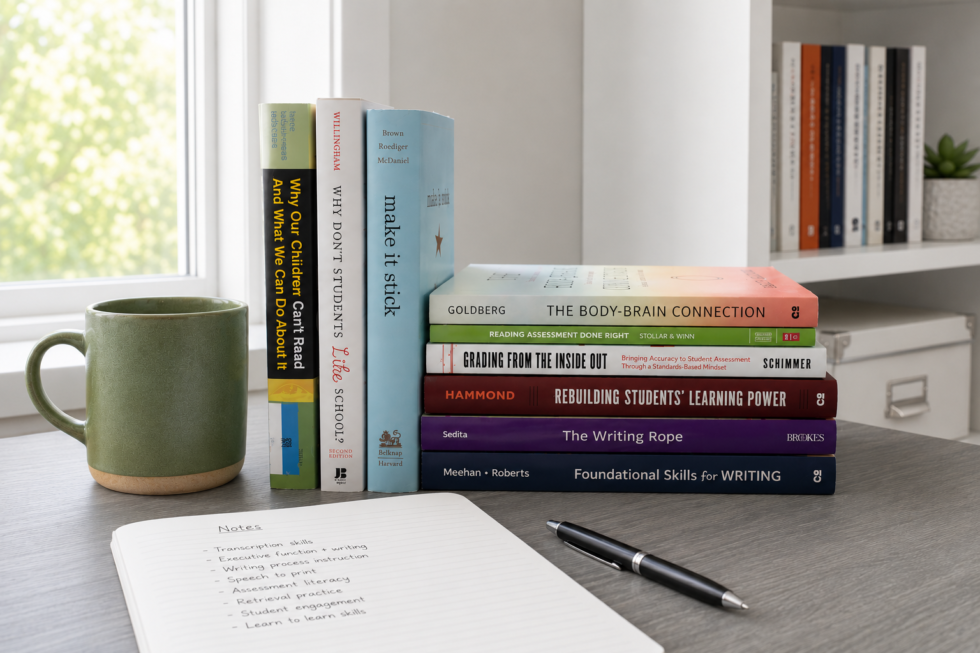
Joan Sedita’sThe Writing Rope helped me more deeply understand the very foundation for writing: transcription skills. There’s a whole section in it that talks in depth about this crucial aspect of writing. It’s also one of the most brushed aside aspects of writing after K/1. It also explained something I see all the time in classrooms (and have certainly experienced in my own): students who have great ideas but struggle to get them onto paper efficiently enough to develop those ideas. It’s true–students need to be able to write and type fluently so that their mental energy can be spent on crafting stronger, better written work.
But there’s so much more involved in writing. Steve Graham breaks down the “must haves” that help elementary students become better and stronger writers in a What Works Clearinghouse IES practice guide (citation below). One of those must-haves involves teaching students how to move through the writing process, from planning to self-evaluating, to goal-setting.
The parts where kids tend to really falter. Why? Because all of these skills involve a high degree of executive function. Underdeveloped executive function skills are the reason we see kids struggle so much to get writing onto the page.
Which is why when I saw the book Foundational Skills for Writing by Melanie Meehan and Maggie Beattie Roberts hit the market, it was an immediate purchase for me. I’ve never seen a book about writing instruction go into executive function skills so thoroughly. It’s an excellent book, overflowing with practical classroom tips around all things writing. (It’s so good, I’m doing a book study with it in my Facebook group!)
And that means…
This book pairs nicely with the ThinkSRSD (now Releasing Writers) training I’ve already completed. Much of this training was just like what I’d learned years ago when I was trained in Writer’s Workshop, but the biggest difference with this approach is that it really gets into helping students with the executive function aspect of writing.
And that’s why, in true Give a Mouse a Cookie fashion, I plan to learn about this even more deeply. Which makes SRSD online* my next stop. The framework was originally developed by Karen Harris more than four decades ago. SRSD has become one of the most researched and evidence-backed approaches to writing instruction available today. Because this training comes straight from the person who developed it herself, I’m very excited to dig into it!
*SRSD online is not affiliated with ThinkSRSD
Teaching Reading
While I read kind of a ridiculous amount of professional books and attend quite a few literacy conferences, social media is another great place to springboard new learning. Like many educators, my training has been mostly grounded in print-to-speech approaches. This approach, after all, is what the most widely used phonics programs in schools are based on. But I wanted to better understand the rationale behind approaching phonics from the opposite direction. Most of all, I wanted a greater set of tools in my toolbelt to offer students who struggle.
Through social media, I’d been hearing an awful lot about EBLI in many groups, so I watched more webinars about it, and started exploring the philosophy behind it. To dip my toe into this learning, I completed the Reading Simplified (level 1) training. So intrigued, I then completed the more in-depth Sounds-Write training.
Which led me to purchase Diane McGuiness’s classic book, Why Our Children Can’t Read and What We Can Do About It. It’s very old, but I’m curious to learn more about the philosophy behind speech to print approaches to phonics to add more to my existing toolbelt.
Assessment
I’ve been a member of Stephanie Stollar’s Reading Science Academy for a couple of years now, and I’m also a frequent listener of the Reading Roadtrip podcast with Kate Winn, so when they started talking about the book they partnered up to write, Reading Assessment Done Right, I knew I couldn’t pass it by. A lot of it reinforced what I already know about assessment, and even called to mind a lot of terms I had learned back in my undergrad studies. But there were also a lot of extra recommendations and resources that led me down some assessment rabbit holes.
Now I find myself digging much deeper into the ins and outs of the kinds of reading assessments we have available to us as well as just assessment practices in general. Which is why Tom Schimmer’s Grading from the Inside Out is now a book I’ve added to my stack.
Teaching Practices
Earlier this year, I read Make it Stick: The Science of Successful Learning. In it, Peter Brown dives deep into the topics of spaced retrieval and retrieval practice. Both are absolute keys to helping students not only learn, but remember it. Making time for this practice–and making it intentional–is something I didn’t do much as a classroom teacher. But after reading this book, I see its criticality.
Which of course led me to an EdWeb webinar on the topic, which was very helpful and gave me tons of practical ideas to run with.
The idea of making learning more memorable then led me to the book Why Students Don’t Like School. It echoed a lot what Peter Brown said in Make it Stick, but it’s written by a cognitive scientist. Through this perspective, the author expands the topic by delving more deeply into what makes teaching memorable. Things like relevancy, connection, and the place of inquiry in learning. It’s a book I wish I’d known about back at the beginning of my career, and it absolutely ought to be a part of every teacher prep program.
This is the book that next led me to yet another next read…
The Body-Brain Connection: Evidence-Based Ways to Reduce Anxiety, Boost Engagement, and Increase Comprehension Across Classrooms. I know the author’s work very well, which means it’ll be a pragmatic, honest discussion, and it will be heavily grounded in a wide body of research. And without a doubt, it’ll be full of classroom-ready ideas I can share with teachers.
This book will pair well with another book I read earlier this school year, Zaretta Hammond’s Rebuilding Students’ Learning Power. I picked this one up after hearing Hammond talk about it on the Cult of Pedagogy podcast. A core tenet of this book is all about helping students build “learn to learn” skills. So many students come to us with learned helplessness. It’s frustrating, to say the least. But it’s not permanent. We can help students take more ownership of their learning, and Hammond shares ways to do just that. This was a book I heavily annotated, and will no doubt reread and come back to again over time.
I guess, in the end, this all just means bad news for my husband.
He’s asked me how it’s possible that after nearly thirty years in the field, I haven’t figured out how to teach yet. He just doesn’t understand the truth in Steve Barkley’s “there is no apex to teaching” philosophy. He has no idea how much professional learning there is to soak in. Yes, it’s bad for my bank account. But it gives me so many more tools to choose from when helping teachers and their students. It’s worth every dime.
And quite honestly, I hope I never reach the point where I think I’ve figured it all out. The day we stop learning is the day we stop growing. Which means, dear husband, the Amazon deliveries won’t be slowing down anytime soon.
Graham, S., Bollinger, A., Booth Olson, C., D’Aoust, C., MacArthur, C., McCutchen, D., & Olinghouse, N.(2012).Teaching elementary school students to be effective writers: A practice guide (NCEE 2012- 4058). Washington, DC: National Center for Education Evaluation and Regional Assistance, Institute of Education Sciences, U.S. Department of Education. Retrieved from http://ies.ed.gov/ncee/ wwc/publications_reviews.aspx#pubsearch.
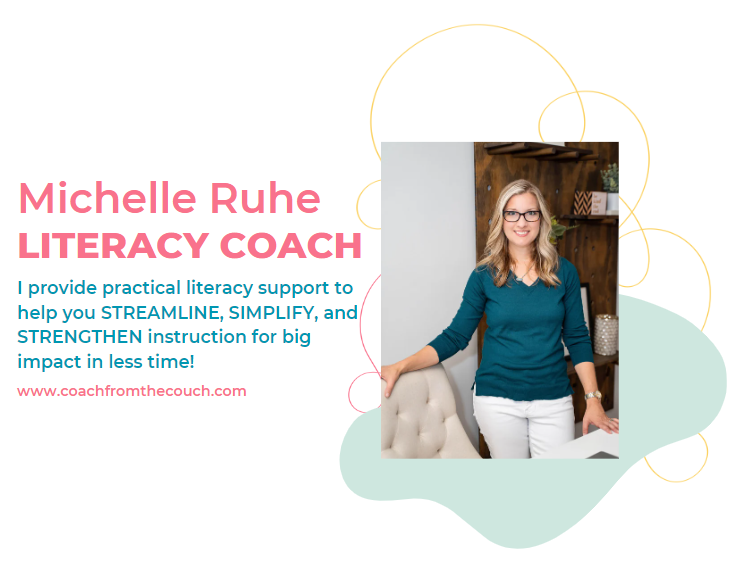
Who is Coach from the Couch? I’m Michelle Ruhe, a 25+ year veteran educator, currently a K-5 literacy coach. I continue to learn alongside teachers in classrooms each and every day. It’s my mission to support as many teachers as I can, because no one can do this work alone. I’m available to you, too, through virtual coaching calls!
Or, consider joining my Facebook community–a safe, supportive environment where you can ask questions, learn ideas, and share your thoughts among other literacy-minded educators!



Add A Comment