

Classroom Anchor Charts: A Tool Worth Keeping
There are things that come and go…and then come right back again in the world of teaching. A “new way” comes in, and we dismiss the “old way” as tired and old-fashioned. But so many times, it turns out that “old fashioned” is actually best. We have several examples of this in the literacy world at the moment.
Before the 2000’s, students wrote by hand, all the time. Then using computers became the “it” thing to do as students used the computer to write. Teachers everywhere said that there was no longer a need to teach handwriting. And now, the research is clear. Handwriting and writing by hand is far more effective for kids than typing. As well, students are reading fewer and fewer physical books, doing much of their reading on screens instead. And, again, this has proven to be a mistake. Screen reading just isn’t good for kids’ attention or comprehension. Maryanne Wolf wrote an entire book about it, Reader, Come Home, that details how screen reading alters the brain’s ability to process text.
Now, across the country, districts that spent a gazillion dollars on 1:1 technology for reading and writing are now backpedaling. They’re closing up the laptops and bringing back good old paper, pencils, and books. Why? Because when we replaced physical tools with tech, we lost something essential. So now, we’re bringing those tools back.
We’re in the midst of yet another “out with the old, in with the new” that will hurt us later example: anchor charts.
Because some people, like this teacher on Facebook, don’t know the value:
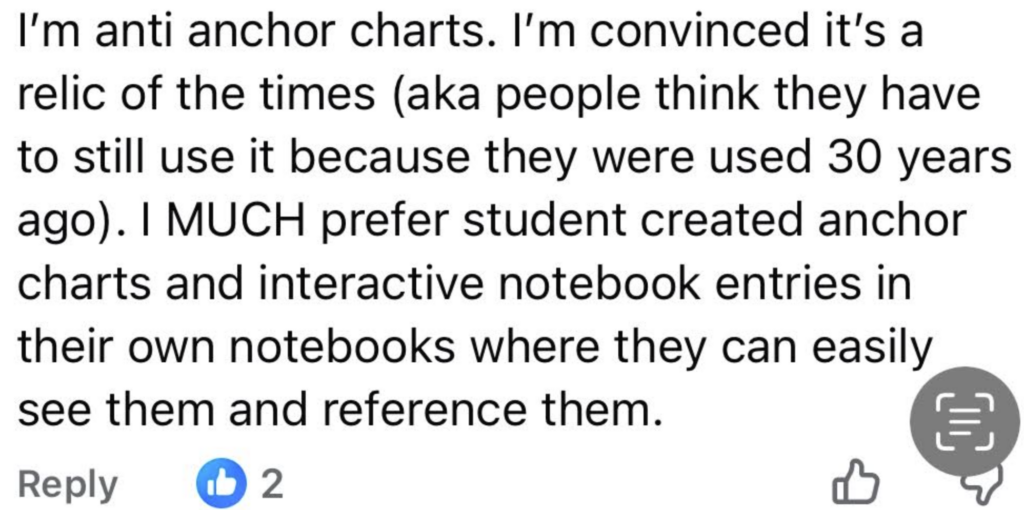
Here’s what this teacher doesn’t understand about the importance of classroom anchor charts.
The very word anchor means “to hold.” They are easily accessible charts that capture the big concepts you’re teaching. The thinking process behind that concept is made visible to serve as a reminder and a guide for students. In their blog post, the authors of the excellent book Smarter Charts say that “[c]harts not only record our teaching, but they are powerful models for children to look towards and mentor themselves to in order to do what they are trying to do even better.” In other words, anchor charts offer students a way to do something with more ownership and independence–something we always want to see.
“Charts are the footprints of teaching, and all charts gear towards growth mindsets because they say, “Look, here is a way to do this tricky thing.” They aid in flexibility and persistence, and they foster independence.”
Kristi Mraz, Co-author of Smarter Charts (2012)
Anchor charts should be very easy for students to see.
We create charts during teaching, which means they may take days to build–no matter what the content area. So in the midst of learning a concept, kids should be able to look to that chart as they apply the same thinking process in their work. It should be easy to simply look up or walk over to it. This also makes it super simple for you, as you work with small groups of kids who need more guidance. It’s a simple matter of gathering kids around the chart so you can practice another dose of application–zero extra prep for you.
Just as your classroom library can really very act as co-teacher, as Colby Sharp and Donalyn Miller say in Game Changer: Book Access for All Kids (2018), so should your classroom walls. What is on the classroom walls reflects what’s important–including the learning going on. Once the anchor chart goes on the wall, kids should know exactly where it is so they can reference it quickly and easily. Which is exactly why I’m not a fan of the notebooks that the Facebook post references. In a nutshell, they’re cumbersome. (More on this later).
Charts on the walls aren’t permanent. They change out as new concepts are taught, and as new ways of working through things (whether that’s annotating a text, solving a math problem, what to look for when editing writing, or any other thing students need to learn) are introduced. The charts change out as the learning evolves. If the same charts remain on the walls well past the time those concepts are being used, or after students have mastered them, then it’s just wallpaper. And wallpaper gets ignored.
Anchor charts are not wallpaper. They’re tools for teaching and learning.
This is why the fonts, colors, and symbols used are so important. Anchor charts do not need to be pretty or cute, but they need to guide students through a process. When creating a chart to walk students through solving a math problem, for example, it helps a whole lot to make each step a different color. Drawing key visuals, like arrows, numbers for steps, or simple icons makes the chart easier to digest than pure text.
The simpler, the better. Even writing key words or phrases on large brightly colored sticky notes makes a very memorable chart. Check out this great Two Writing Teachers post all about anchor charts to see some excellent examples of the sticky note idea in practice. It’s applicable to all subject areas.
Keeping it simple and not worrying about beautiful calligraphy and perfectly straight lines (or even a misspelled word) is key to making them work as teaching tools. The goal is just to capture the learning. Not create an award-winning display. Simple is best, and simple is fastest.
Teachers sometimes have students copy the charts that were made during teaching into “interactive” notebooks. There’s nothing interactive about this. And if kids just use one pen or pencil to do it, the importance of different colors/fonts is lost.
Here’s another big reason it’s not helpful for students to copy these charts into their notebooks–maybe even the biggest reason of all.
Classroom anchor charts are most effective when created with students, during the learning. It’s the whole idea of multiple modalities for learning taking place. What is taught out loud is made into a visual. When students also play a role in constructing what gets put on the page, they are more invested–and they understand it better (International Literacy Association, Motivating Readers, Inspiring Teachers, 2014).
Because it’s much harder to keep displayed, using an anchor chart found online that you and your students weren’t a part of creating will never be as effective as co-creating it as instruction takes place.
Remember, pretty or cute doesn’t matter. The point is to capture the learning, and then use it during guided and independent practice. And that’s the rub that that Facebook teacher hints at. If an anchor chart isn’t used, it’s a waste. Which means we must be judicious about what’s anchor chart-worthy and what’s not. Everything doesn’t go on a chart. Concepts that are complex, important, and enduring do.
Which is also why I just can’t agree with that Facebook teacher when she says she prefers “student-created” anchor charts. If students create their own chart, you could end up with 25 different interpretations of what you actually want them to learn. The concepts that go on an anchor chart require our guidance because they’re complex. We want to be sure that what goes on the chart is clear and correct so the learning is consistent from student to student.
Many of our curriculum programs include ready-made anchor charts. What about those?
For those, I’d say that if they’re simple enough to recreate with kids as the teaching takes place, do it. Very often, there are parts of it that don’t fit what you’re teaching or don’t fit your standards, so teachers need to modify them anyway. If they’re more involved, or what they have really is exactly what you need, then lean on it as you teach. We don’t want to just display a chart as a cute image and never even reference it. If it’s just going to hold space on a slide but kids don’t really know what it says or it’s too small to read (and it isn’t going on the wall), it’s pointless.
A few last thoughts about why classroom anchor charts trump interactive notebooks.
Interactive notebooks are a lot like reading logs. They tend to be a lot of work for little to no benefit. I’ve tried them both too, so I learned the hard way.
Because anchor charts are most effective when co-created with students during the learning, anything that was created by someone else, outside of your classroom context, will not be nearly as effective.
More importantly, this does nothing to foster critical thinking. Co-creation matters. Authors Stephanie Harvey and Anne Goudvis, in their book Strategies That Work: Teaching Comprehension for Understanding and Engagement, remind us that “[a]nchor charts provide a record of our instruction. Anchor charts make both the teacher’s and the students’ thinking visible and concrete.” (As found in International Literacy Association, Motivating Readers, Inspiring Teachers (2014), emphasis is mine).
If the kids’ own processing isn’t a part of it, it’s not going to be memorable. And if it’s stuck in a notebook, not used for later lessons, referenced during small group instruction or 1:1 conferring, it will do students no good.
What’s more, those TPT downloads of foldables and guided notes and things of that nature are time-consuming and cumbersome. We don’t have extra time to spare. In theory, these tools could work. In theory, yes, “students can easily see them and reference them.” In practice though, they rarely do—and the time cost far outweighs the benefit. Spending time on something that has nothing to do with the actual learning–cutting, gluing, and folding–is a waste–unless a teacher really and truly uses it during lessons, references them during small group instruction and/or 1:1 conferring. It also cost you precious minutes during prep time you could have used for something else.
What’s way faster? Creating a chart as you teach and leaving it on display.
Students should be able to instantly find what they need, take a look at it, and get back to the task. Not spend time looking for their notebook then more time rifling through pages to find what they need.
If you really want students to have these charts in their own notebooks, then I suggest snapping a picture of it and printing it. That way all the parts that make it memorable, from the co-construction to the colors, fonts, and symbols, are the same. It’s only an anchor chart if kids can really anchor to it, after all. This also makes it super easy to share with parents in your newsletter, on your class website, or as a tool to reference for homework, which is a big help for families.
Anchor charts aren’t old-fashioned. They’re a very important tool for teaching and learning.
They’ve been around for “30 years” for the same reason handwritten work and physical books have proven to endure: they support how humans actually learn.
They make thinking visible.
They slow us down and help us process.
And they remain accessible long after the lesson ends.
Yes, anchor charts take effort. They require us to think carefully about what’s worth capturing and building them intentionally with students. But that work pays off—because the chart is so much more than paper on the wall or box for admin to check (another Facebook post I saw). It’s a shared reference tool. It’s a scaffold. And it’s a reminder that learning doesn’t live in a program, a slide deck, or a notebook. It’s a part of the very environment in which the learning takes place.
The most effective tools don’t need to be flashy or cute. They just quietly do their job, day after day, helping students anchor their thinking and move forward with independence.
And that’s not old-fashioned at all. That’s really good teaching.
P.S. If anchor charts are new for you, don’t be nervous! I highly recommend this article. It’ll tell you so many important things to consider!
If you could use some help with figuring out what’s anchor chart-worthy in your upcoming lessons, I’m here for you! Simply email me at michelle@coachfromthecouch.com or reach out for a coaching call.

Who is Coach from the Couch?? I’m Michelle Ruhe, a 25+ year veteran educator, currently a K-5 literacy coach. I continue to learn alongside teachers in classrooms each and every day, and it’s my mission to support as many teachers as I can. Because no one can do this work alone. I’m available to you, too, through virtual coaching calls!
And, be sure to join my Facebook community–a safe, supportive environment where you can safely ask questions, gain ideas, and share your thoughts among other literacy-loving educators!


Add A Comment